

You must give everything to make your life as beautiful as the dreams that dance in your imagination. -
Roman Payne
BE FREE - SEEK ADVENTURE - LIVE SIMPLY
The Cost to Live Aboard a Boat
One of the main questions we get asked is how much it costs to live this live aboard and cruising life style, especially on a powerboat, motor yacht, or trawler. Well we’ve been tracking our expenses for two full years now, and we are going to break it all down for you here. We will even do a deep dive into our boat maintenance including repairs from our Hope Town accident and the blown head gasket. This may be a shocker for some of you.
One of the main questions we get asked is how much it costs to live this live aboard and cruising lifestyle, especially on a powerboat, motor yacht, or trawler. Well, we’ve been tracking our expenses for two full years now, and we are going to break it all down for you here. We will even dive into our boat maintenance including repairs from our Hope Town accident and the blown head gasket. This may be a shocker for some of you.

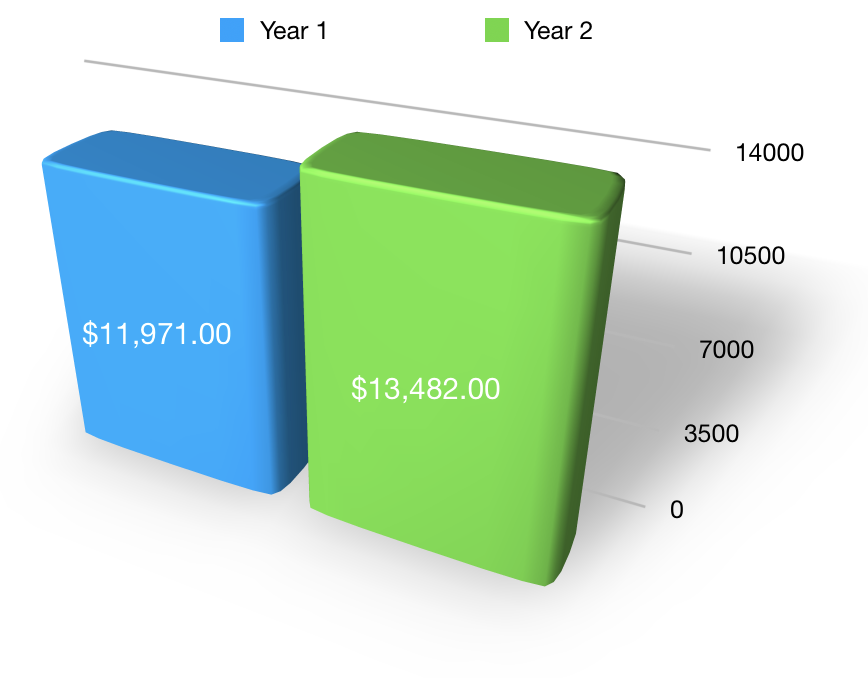
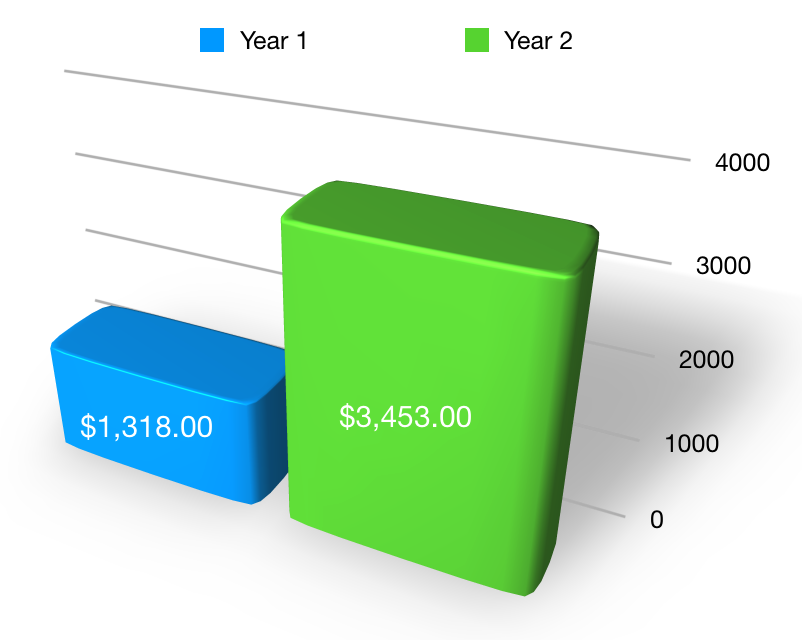
Before we dive in, let’s total it all up to compare the total boat and cruising related expenses for the two years. As you can see, if we were to look at this monthly, that would be $6426.00 per month in year one, and $4468.00 per month in year two.
Disclaimer, this isn’t everything we spent in those two years. This is cruising and living aboard related expenses. We had other personal expenses that we don’t feel are of value to share, things like donations, life insurance, etc. This should be decent news for most people wondering what their monthly expenses would be, we’ve had so many people ask if they could do it on $5000 a month. Given these numbers we’d say that is a YES, that is certainly possible!
Take a look at how our expenses are dispersed. We can talk percentages here as we think it will be more applicable to apply to your budget.
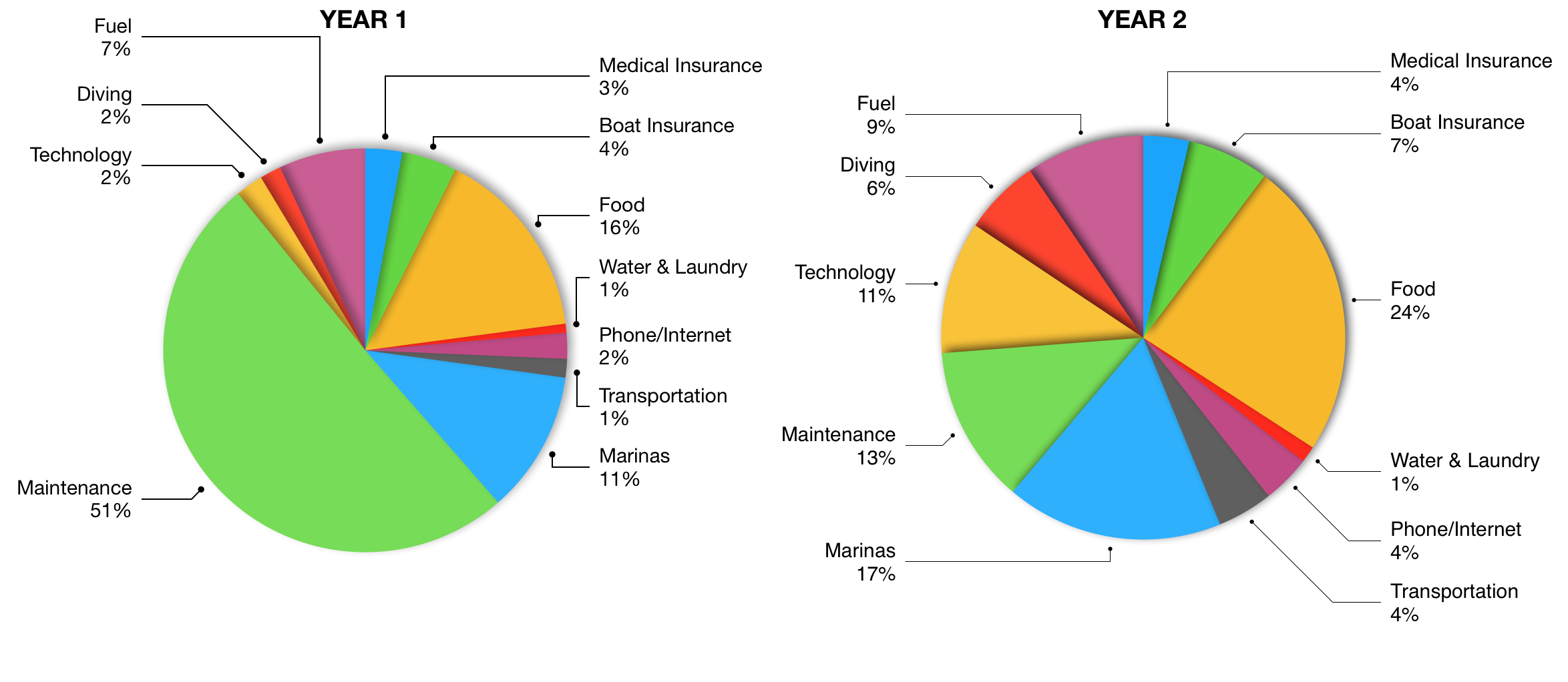
Let’s get into the specifics. We’ve released two companion videos on this topic, and it’s a good idea to give them a watch before proceeding through the section they are posted in.

Medical Insurance
Our medical insurance is going to apply more closely to Canadians than it is Americans or anyone else in other parts of the world. We are currently under our Canadian Ontario Health Insurance Plan (OHIP). When we travel out of the country, we add travel medical insurance. The insurance companies give us a much lower premium when we have the backing of our Canadian health plan. We use The Co-operators which averages about $6.25 CDN per day for the two of us together.
OHIP allows you to be out of the Country for 7 months a year and still be covered. It also has a benefit that allows you to be away for 2 full years every 5. This is something not everyone knows to take advantage of in Ontario. However, if you require to be out of the province more than this, you would need to get Expat insurance which would cost much more than travel insurance with a valid OHIP. Expat insurance could be a future option for us, as the cost to travel back to Canada each year vs the cost of expat insurance may be about the same. For anyone who lets their provincial healthcare expire, it would only take 3 months to reinstate it once you return. Please note each province in Canada has different requirements, so please check your provincial plan for specifics.
How does this compare to land-based living?
Since we are under OHIP, which is government-provided health care, any extra cost we have is something we wouldn’t have while living in Canada on land.

Water & Laundry
As mentioned in the video we don’t have a Water Maker, so when in the Bahamas we have to pay for water. We hold 150 gallons of water and we can push that to 3 weeks if we need to. There are places to get free Reverse Osmosis water in the Bahamas, but they are usually not a place that will allow the boat to dock and fill up. We carry water containers for these free places and maybe fill these up and dump into the tank. We can extend our water for 3-4 days doing this.
There is not too much we can say about laundry. It is what it is. We pay for it in the US and in the Bahamas. The average cost to do laundry in the US is about $1.50-$2.00 for a wash or dry, and in The Bahamas it is about $3.00-$5.00 for a wash or dry. So 1 load of laundry in The Bahamas is about $10. One tip though, if you are in the Exumas, and you need to stay at a marina for a little bit, Emerald Bay Marina on Great Exuma has free laundry for those staying at the marina.
How does this compare to land-based living?
It is reported that Canada’s average household water bill is around $33 per month. That’s pretty cheap compared to most of the world. So in this category, water is much more expensive than land-based living. At least in Canada.
Food & Groceries
The prices for groceries include anything from laundry detergent, sunblock, paper towels, etc. Essentially anything that can be bought at a grocery store is included in these numbers.

How does this compare to land-based living?
This averages about $1000 per month in Food and Groceries. If we remember correctly that is about what we spent in our land-based life. We buy and eat the same things, eat out the same amount. So we guess this one is about equal, for us anyway.
Fuel
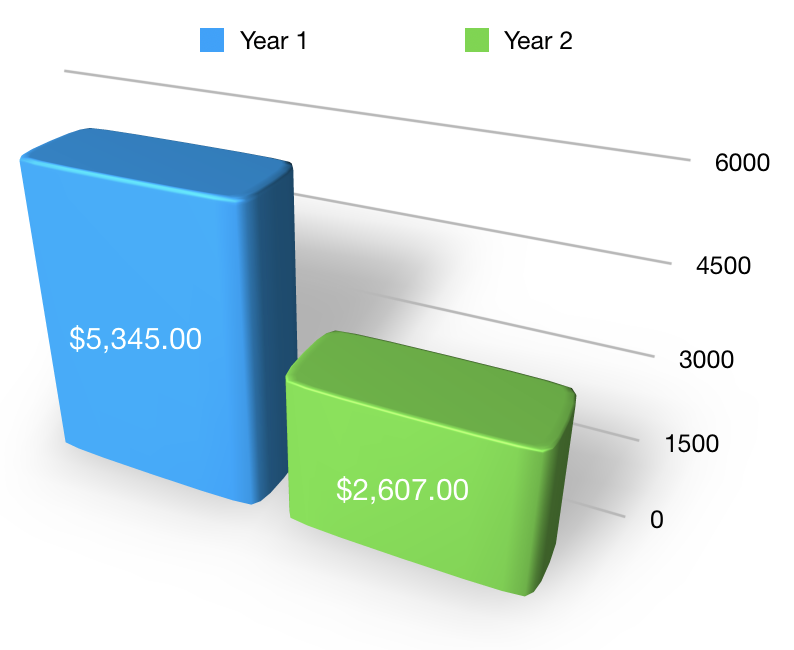
As mentioned in the video, year one we travelled from Ontario Canada to The Bahamas, cruised The Bahamas for 6 months, then headed back to Florida. Year two we travelled from Florida to The Bahamas, cruised The Bahamas for 8 months, then back to Florida.
How does this compare to land-based living?
The only thing to compare this to, from a land-based living perspective, is a car. When we lived in a house we had at least one car, sometimes two. With the one car, fuel for the year would be $3500, which included a lot of commuting to work. We think that is pretty comparable. If you add in the cost of maintenance on the car and insurance, well the car becomes way more expensive than the fuel for the boat. Even if you add in the Dinghy cost and maintenance (as if it was our car), land-based live is still much more expensive.
We do wonder though, what pollutes more, a boat with Diesel engines scooting around the Bahamas, or a car used for committing to work and traveling? If anyone has an opinion on this please comment below.

Phone and Connectivity
Staying connected while cruising is very important to us. We work remotely while in the Bahamas, and a day with a loss of connection is money lost. It is one of the main reasons we have not ventured south of George Town Exumas. We are afraid of getting stuck without a connection in those southern remote islands. We even wonder what connectivity would be like in the rest of the Caribbean? Being without a connection will be detrimental to our ability to do this lifestyle long term.
What Services We Use:
magicJack gives us a Canadian phone # for family and friends in Canada to reach us without long-distance charges. We have the app on our phone that we use for calling. We can even plug a real landline type cordless phone into the small device connected to our router and it behaves like a landline. The cost per year is $55 CDN.
T-Mobile is who we use when in the US and Canada which provides us with unlimited calling to US/CDN and unlimited data. They claim they may throttle you with heavy data usage, however, we are heavy users and we have rarely noticed any degradation in speed. We use the hotspot on the phone for our internet. The cost per month is $100. When we go to The Bahamas we suspend our plan which costs $9.99 per month. A quick call to T-Mobile when we return to the US has us back online.
While in The Bahamas, we have used all of the below and all are reliable and reasonably priced options.
My Island Wifi is a relatively new service in the Bahamas. It provides an economical way to get unlimited unthrottled data while in the Bahamas. A rental plan of $75 per month for unlimited data. There is a $50 deposit fee and a $10 delivery fee. The $50 is refunded once you give back the device. They have a very personal service and are happy to help you out to get all setup. This has become our go-to service for data when in the Bahamas. Check them out at My Island Wifi at https://myislandwifi.com
BTC has been around the longest, and the data plans use to be the most expensive. However, with competition increasing from Aliv, you can now get good prices on data. For the cost of $29.99, you will get 15 GB of data and 1000 min of calling to US/CAN for 15 days. You can easily top up if you run out of data. We go over the 15GB way before the 15 days and just top up when needed. The average cost for us to use this service when not having My Island Wifi is about $120 per month. There is also a 9.99 plan that gives you phone and 1GB of data. This is what we pair with My Island Wifi to give us a local phone number when in the Bahamas. You can check out their site for more options. https://www.btcbahamas.com/explore/mobile/prepaid
Aliv: Aliv is not everywhere in the Bahamas just yet, but if you are in a covered area, it’s a great option. The cost for unlimited internet and calling to US/Can is $140 per month. When we tested it, we found Aliv to have consistently the fastest data throughput of all the competing services. Check out their plans at https://www.bealiv.com/shop/prepaid-plans
Coverage while cruising
Besides the open ocean many miles from land, there were only a few spots we can think of where connectivity was a problem. One is In North Carolina. From Albemarle Sound to Pamlico Sound via Alligator River is pretty much a dead zone. Don’t expect to be doing much web surfing during that passage.
In the Bahamas, the only real dead zone we have encountered is in the Exuma Land and Sea Park. You can get a connection on the fringes of the park, but nothing spectacular. You can also grab a bar or two on BoBo Hill at Warderick Wells, but again, don’t expect to be impressed. We love the park and would spend much more time in it if we had a decent connection. Wonder if we can petition someone to put a cell tower or two throughout the park?
How does this compare to land-based living?
From what we can remember, this is either equal to or cheaper than what we had in our land-based life. We paid $100+ for internet service to our home, along with a cell/data plan for our mobile phone at another $100+.

Transportation
Getting around on land when you are bound by water is getting much easier than it used to be. Bike or scooter rentals are getting much more common. The advent of Uber/Lyft has given most places an easy and affordable guaranteed mode of transport. In the Bahamas, you can count on golf cart rentals or regular car rentals if you are on the bigger islands.
If you are wondering what it might cost to fly in and out of the Bahamas, well we have some good news. Cyndi flew out of Great Exuma Island, it was January, and she got a one-way ticket at short notice for $400 from the Bahamas to Toronto with one stop in Atlanta on Delta and $240 US on the way back. That is pretty cheap. Not sure if the price was due to the time of year or what, but it does let us know that you can get some good flight deals.

How does this compare to land-based living?
Planes, trains, and hotels can probably be compared to a yearly vacation or two which most people take. The rest can be compared to owning a car. Since we already offset the fuel cost of the boat with the car, then we don’t have anything to offset these transportation costs with. However, if you are a 2 car family, then this will more than offset that. A second car would be much much more expensive than these transportation costs.

Marine Insurance
We are with BoatUS/Geico with a Bahamas extension on the policy. They said that the premium cost increase in the second year was due to hurricane Irma the previous year.
Our insurance policy allows us to go as far south as Turks and Caicos, and during hurricane season to be in the US or Bahamas with a good Hurricane plan sent to them. If we were to go further south into the Caribbean, we don’t know how much extra the extension for that would cost us.
It may also be worth noting that before venturing on this journey, we had 20 years of boating experience on the Great Lakes and tributaries. If we did not have this, our insurance premium would have been higher. Some companies will not insure you for this type of voyage if you do not have much experience.
How does this compare to land-based living?
Even in land-based living, we would always have a boat. We can’t imagine life without one. We would be paying some sort of marine insurance anyway. Our policy on our last boat which was used seasonally up north was around $1500. So it is more than double that to head south in a bigger boat.

Marinas & Mooring
Anchoring is our preferred way to spend our days on the water. However, we have found that marinas are required more than we thought they would be. When you run into certain mechanical issues, there is nothing like the security of a marina to accomplish the fixing of said issue. Sometimes, the bad weather is such that a marina makes more sense safety-wise. Also when doing major provisioning. Being at a marina makes loading the boat much more convenient.
There is also the fact that sometimes we just want to stay in a marina. At times, it is convenient to facilitate exploration or take in shore events that may be happening.

How does this compare to land-based living?
If you are one that, like us, would own a boat even if you are living a land-based life, then you will always have marina fees. If seasonal like we would be in Canada, you would have winter storage fees as well. For our 34 foot boat we had previously, we paid $2150 for Winter storage and around $3500 for summer dockage. Though the total of that isn’t the total of the marina and storage costs of our 44 liveaboard, but it’s close.

Technology
Besides a used iPad Pro 12.5” that we bought used for $400 that is used to supplement navigation, this category is really not boating or liveaboard lifestyle related. However, we decided to add it in just so you can see what video production may cost if you plan to cruise and do a YouTube Channel, or even if you don’t have a YouTube channel, you might take a lot of video and photos for your friends and family to enjoy on social media.
If there was one video camera that we think every cruiser should have it would be the GoPro, and not just any GoPro the Hero 7 Black or the Hero 8 Black. These cameras have gotten really good. With Hypersmooth video capture and the fact that you can take it underwater with you, makes it the go-to camera for your boating adventures. We picked up a GoPro Hero 7 Black in year 2, and we will be picking up a Hero 8 Black very soon.
Also in year two, we picked up a DJI OSMO Pocket, a DJI Mavic 2 Pro drone, some microphones, and other video production equipment. One of the biggest things in year 2 was the fact that we lost a hard drive with a season worth of video, and it wasn’t backed up. Because of this, we bought a new Network Attached Storage device of 16 TB for $1000, to supplement our existing 12TB NAS that was full. We also spent $1000 on getting the data off that bad drive and transferred onto the new 16TB NAS.

How does this compare to land-based living?
We probably spend much more here than we would if we were on land. Though being techies and loving to take photos and videos I’m sure we would have found an excuse to buy similar equipment. We will call this one about equal.
Diving
We know not everyone dives, however, it is good to see what scuba could add to your expenses should you decide to take it up while cruising. We love it and can see ourselves spending more on this activity in the future. If we ever have a season without a boat, we will likely take a liveaboard dive vacation.

How does this compare to land-based living?
Diving is all extra expense for this lifestyle. We probably wouldn’t be doing scuba diving back in Canada.

Repairs & Maintenance
This is always the category potential live aboard cruisers worry about the most. The maintenance is predictable enough, it’s the stuff that goes wrong that you had no idea was coming. This is understandable, but the fear is usually misplaced. One’s due diligence here is what you should rely on to curb the fear. A good marine survey before you take possession of the boat, along with a separate engine survey by accredited technicians of the brand of engine you have. Doing regular oil analysis on the engine fluids. Then making sure the engine has been serviced correctly and good records kept. If you have done those things, you have done all you can do. Things will still go wrong, but a well-serviced diesel engine usually doesn’t just break catastrophically.
Let’s define our terms here. We view regular maintenance as any predetermined scheduled maintenance. Things that have to be done every so many hours to keep things running smoothly. Things like oil and filter changes, fuel filter changes, even things like scheduled fuel injector cleaning, or valve adjustments.
Repairs, of course, are the unexpected things that fail as we cruise. Things that may break or fail prematurely, or because of an accident. Things like pump failures in the engine or otherwise, impact damage above or below the water, something blows up, electronics suddenly stop working, and even blowing a head gasket.
Parts are items that we buy as spares, just in case something fails or for future scheduled maintenance. Parts purchased at the moment to repair something unexpected are included in repairs, not parts.

Let’s break down year one’s repair costs. $14,000 Was a direct result of the accident in Hope Town. The largest thing that was not covered under insurance was supplementing the insured paint job with what should be done to make the paint job correct; Bringing the paint down to the edges of the nonskid on the deck, instead of stopping the paint at the cap rail in the aft cockpit. Also painting the blue stripe on the flybridge, since the other blue stripes were getting painted, this would look really faded against the new. Taking the boat apart to prep for paint we noticed that the bow pulpit had enough rotten wood in it that it needed a total rebuild of that wood bracing.
Another thing that bumped the repair costs up that year was the turbos. We pulled into North Carolina to see our trusted mechanic because we noticed an occasional loss of power on the port engine for two days. We didn't narrow down what the problem was, and we didn't notice it again afterward. While in North Carolina, our mechanic noticed that someone jammed engine pencil zincs in a place near the turbos on both engines. They could not be removed without removing the turbos on both engines. They were probably there for a very long time, but if they broke off they would get sucked into the turbos, wrecking them. I didn't want to have the turbos destroyed at an inopportune time or a remote place, so I decided to remove the turbos to get the pencil zincs out. When we removed the turbos, we decided to replace them since there was enough gunk in there that eventually it was going to cause problems. $4000 later we had new turbos and the problem zincs were removed.
To be honest, If we had known what was coming next with the head gasket and fuel injection pump, we would not have fixed the misplaced zincs or turbos but left it all in place. It probably would never have been a problem. When we did the head gasket repair in Freeport and things were put back together, we found the fuel injection pump not working. We replaced that with a rebuilt unit. We are thinking the fuel injection pump may have been the source of the problem we encountered coming into North Carolina.
Though not everyone is going to have an accident like we did, nor blow a head gasket as we did, it is still wise however to have a way to pay for large unexpected repairs. In general though, if we remove the $14000 from the total, then average that over two years, you get just above 10% of the value of the boat. That is sort of the common rule of thumb. Expect to have 10% of the value of the boat in repairs and maintenance per year. Some years it will be over, some it will be under, but for an older boat, we think 10% is a good expectation, especially if you are living aboard and cruising full time.
One thing is for sure, we hope not to have $40000 in repairs and maintenance every year, if we did, we would not be able to afford this lifestyle.
How does this compare to land-based living?
When comparing this to repairing and maintaining a home, we are going to assume if you have a more expensive boat, you will have more expensive maintenance, and you have a more expensive home with more expensive maintenance. For us, The cost of maintaining and repairing our home, along with the equipment to own to maintain it (lawn tractors, snowblowers, etc) was absolutely $10,000 or more a year, but until we go a few more years without any unexpected high repair costs, we are not going to say living aboard is cheaper. It possibly is, we just don’t have enough personal information to make that judgement.
If you are still reading, we hope you enjoyed and got something out of that breakdown. In hindsight, this post may be a bit too long and we probably could have broken it up. Oh well.
We will keep tracking our numbers and hope to make costs update posts in the future. If you have any numbers to share we would love to hear them. We are very curious about the comparison to other cruisers in other types of boats. For example, do newer boats have the same cost ratio for maintenance? Do single engine trawlers experience the same yearly costs? Does a sailboat offer any savings or does rigging cost as much as maintaining an engine? We are still learning, and the learning will never stop.

The First Searching for C-Shels Interview
We did an interview! We were sitting back one day doing some video editing and we get a direct message on Instagram from a lovely fellow, Captain Frank, from The Ships Log requesting to sit with us and have a chat. We felt honored that someone would take the time out of their day to talk to us, so we immediately said yes.
We did an interview! We were sitting back one day doing some video editing and we get a direct message on Instagram from a lovely fellow, Captain Frank, from The Ships Log requesting to sit with us and have a chat. We felt honored that someone would take the time out of their day to talk to us, so we immediately said yes. Captain Frank wanted to meet face to face as we headed up the east coast this year, but we don’t think we are taking the boat that far north, so a face to face over Skype while we were in the Exumas had to do.
We answer a bunch off questions, some of which you may not know about us and what we are doing.
How did we transition from land to live aboard? Do we miss anything about living on land? Our favorite destinations so far? And what are our current plans?
All these and much more are answered in The Ships Log post Leaving Land Behind. Thanks Captain Frank!

DIY Locking Swing Arm TV mount for Boats
There are plenty of expensive and laborious ways to install a TV in your boat. From integrated wall displays to electronic popup out of cabinet rigs. But what if you wanted to save some money for other things on your never ending boat project list, and save some time with an easy to setup system that is secure and versatile, using products and parts you can get today?
There are plenty of expensive and laborious ways to install a TV in your boat. From integrated wall displays to electronic popup out of cabinet rigs. But what if you wanted to save some money for other things on your never ending boat project list, and save some time with an easy to setup system that is secure and versatile, using products and parts you can get today?
To be honest we've gotten a lot of questions about our TV setup since the short installation clips in a couple of our videos. So much so, that we thought a separate blog post about the products used and an update on how its holding up are warranted. Here are the clips in question;
Skip ahead to 8:18 for TV portion.
Skip ahead to 11:15 for TV portion.
We had to be selective on the TV mount. The base could be no wider than 4 inches and the mounting screws or bolts needed to be at the centre of the mount not on the edges. This is because we wanted to mount the TV directly on the wooden column on the port side of the boat where there is a channel for wires to route from the flybridge to the salon or engine room. This would allow us to take the cover off the channel and backplate the mount with a piece of teak or mahogany and through bolt it. This would give it some extra strength in rough seas, with no risk of damaging the wooden cover. The TV mount we ended up going with is the Kanto M250 Motion. This one is rated to take up to a 55 inch TV. So with the sub 40 inch TV we have we thought this would provide the strength needed in the swing arm. Our advice, for a boat, is to buy a mount that is oversized for the TV you are trying to mount.

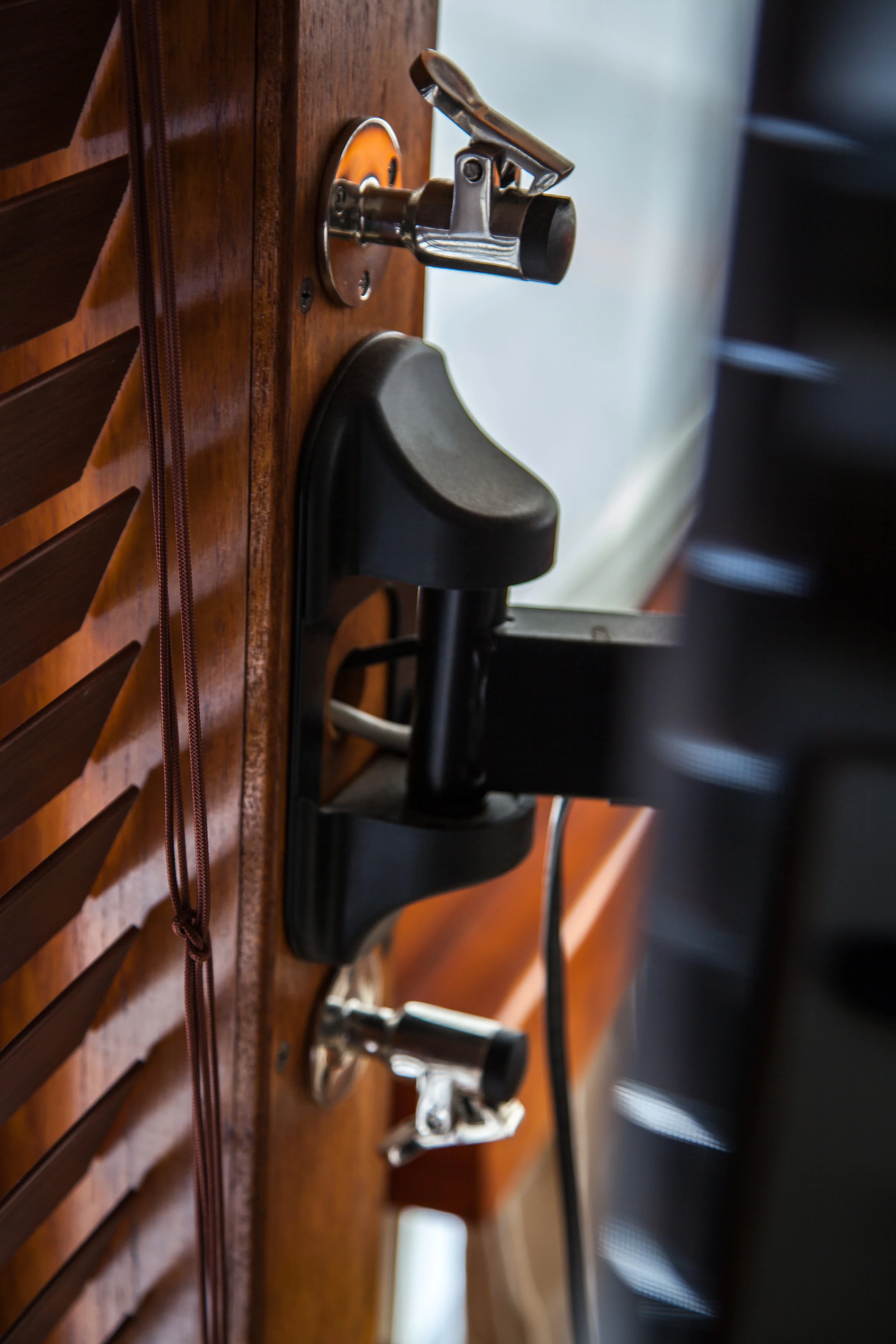
We tried to find a locking TV mount. These are usually considered RV mounts. The problem we found with swing out RV mounts is that they are rated for smaller TVs, and the bases that mount to the wall are usually bigger. Also, on some of them the pin that locks the swing arm in place doesn’t seem robust enough for our liking. If your mounting location is not as restrictive as ours, you may be able to find an adequate locking TV mount.
So how did we lock our TV that didn’t come with its own lock? Well it was mentioned to us once that marine door latches could work well for securing a TV. The latches we went with were the SeaLux Marine Stainless Steel Stop-N-Catch. These marine door latches keep doors from swinging due to pitch and roll of the boat. We chose two of these, one above the TV mount, and one below the mount. The movable trigger latch gets secured to the wall.

The risk here and the weakest point in the installation is that you have to screw the small L brackets into the back of the TV somewhere with shallow screws. As TV’s get thinner, it may get harder and harder to find a place to screw into. We initially screwed them in thinking they would eventually start pulling out. Then we would take the back off the TV and put small bolts in with washers and nuts to hold it secure. Surprisingly however, the screws have never pulled out of the back of the TV.
This setup has served us well now for almost 3 years. We have been in some very rough conditions at times, and we even forgot to lock it a few times in moderate seas on the Chesapeake. The mount nor the latches show any signs of fatigue or wear. It is serving us well and can see it continuing to work for years to come.
We hope this info may help you in your planning and purchasing a system to mount a TV in your boat. Just remember, the boat isn’t somewhere you should be going to watch TV very often. Watching sunsets are much nicer.

Hope Town Bahamas & the Details of our Accident
Hope Town, one of the most lovely little villages in the Abacos. With its brightly colored houses, walking paths, quaint shops, and the protected harbor, one can have a wonderful experience with an extended stay here. We had a mountain top experience here, but also went through the valley...
Hope Town, one of the most lovely little villages in the Abacos. With its brightly colored houses, walking paths, quaint shops, and the protected harbor, one can have a wonderful experience with an extended stay here. We loved Hope Town and all it had to offer, as you can see in the video below.
One of the biggest treats was to tour the candy cane lighthouse, take in the fabulous view at the top, and it was such an educational experience watching the old girl light up. We were on top of the world literally and figuratively. Our Bahamas experience up to this point was nothing but blue skies, sandy beaches, and conch blowing sunsets...
Photo By C-Shel Photography
Photo By C-Shel Photography
Photo By C-Shel Photography
Photo By C-Shel Photography
Photo By C-Shel Photography
...and then this happened.
We've had a ton of questions since we release the Disaster in Hope Town video, so we will try to give some extra details here to fill the gaps in the video.
When you take a mooring in Hope Town, we were told you just go in and pick an open mooring and the mooring renters will come out and collect money when they see you on it. Moorings are owned by marinas, restaurants, and we believe some are privately owned. We entered the harbour and picked one of the only moorings left in the mooring field. No one came out to collect any fees however, which we thought was odd, so we just went into town and thought the person collecting the money for us would get us the next day.
To clear some confusion some of you may have, a mooring is float connected to a chain or rope to something secure on the bottom like a concrete block. You pick up an eye in a line or at the top of the float connected to the chain and you put lines through it and secure it to your boat at the bow. The moorings are usually installed and maintained by marinas. Some people are confusing moorings with anchoring. Anchoring is when I lower my anchor from the bow of my boat attached to a chain to my boat. You put out enough rode (line or chain) to give you some good scope and good angle so when you pull on the anchor it pulls into the bottom instead of pulls out of the bottom. This usually means putting out 5-7 times more rode than the depth of water you are in. This system is maintained by the boat owner. What a mooring provides over an anchor is that moorings do not need the scope of an anchor system and can have chain from the concrete block to the float straight up at a 90 degree angle. This allows more boats to fit into a harbour because you don't have to allow for as much swing room for the boats when the wind changes as you would if you were anchored with 5-7 scope. Hope Town is a mooring field and no anchoring is allowed.
What exactly happened to our mooring that night? Well, this mooring was so ill maintained that the chain broke from where it attaches to the mooring block on the seabed. We don't know if it was a shackle holding the chain to the block that broke or if it was an actual link in the chain. As you can see here, the chain was in pretty bad shape.

As you can see in some of the images above this mooring field is tight. Not a ton of room between the boats. Being so little room, the first boat that hit on our port side, happened in a matter of seconds from the mooring breaking. This first impact smashed the salon window, bent and broke our railing, along with some fibreglass damage. In the confusion, we managed to start the engines and push off of the first boat. We were motoring around the mooring field not able to leave the harbor due to the 30 knot sustained winds coming directly across the Sea of Abaco and into the entrance of the harbor. Otherwise we just would of went outside the harbour and anchored. In the confusion we snagged mooring with a sailboat on it with our starboard running gear. This wound the mooring line up onto the shaft and in doing so pulled the bow of the sailboat, anchor and all, down the starboard side out our boat, ripping the rubrail off and gouging the hull, then finally resting with our stern quarter to their bow pulled tight against us. Our engine stalled out with a puff of smoke from the strain and sudden stop. This is where we spent the night.
What could we have done to avoid this, and what can you do in the future to avoid the potential for such a catastrophe?
Use your anchor instead of a mooring. You know the condition on your anchor system on your boat. With good anchoring techniques, in a protected roomy place, it is our opinion that a good set on your anchor with lots of scope out is safer than a mooring in a close quarter mooring field.
Never take a mooring where you do not know what establishment owns it. Radio the marinas and ask which ones are theirs and how to identify them.
Back down with your engine(s) once secured to the mooring. This will put enough tension on the mooring to simulate a fairly reasonable wind.
If at all possible dive on the mooring and inspect it yourself. If in doubt at all, move to another mooring.
Always use an anchor alarm. We use anchor alarms when anchored so that we will get a loud alarm on our mobile phone or chart plotter if we move outside of our pre-defined swing radius. An anchor alarm would not of saved us that first hit that night, we think it took 2-5 seconds to hit the first boat and an anchor alarm would not of went off in that amount of time. However, if we missed that first boat and started to drift farther and longer, an anchor alarm would have alerted us of the situation, maybe in time to do something about it.
Use a watch system. In a storm, it is a good idea to have someone always at the helm ready (on watch) to react to a potentially dangerous situation. Be it your mooring breaking, your anchor dragging, or it happening to someone else and they are drifting toward you. Do on watch shifts with your crew so one person doesn't have to stay up all night.
Always secure your dinghy in such a way that it allows you freedom to maneuver and escape a dangerous situation. This usually means hoisting the dinghy into its davit for as if you were going to travel.
If you are near Hope Town when you get northerlies, and you don't want to take a mooring or a marina, there is one place you can quickly get to that we have found to have great holding and good protection.

Our insurance company was fantastic through most of this ordeal. They agreed to pay for a patch up job in the Bahamas, which was done at Marsh Harbour Boat Yard, and then pay for the real fixes when we got back to the US/Canada. For most of the work the Bahamas yard would not be able to completely fix everything properly. They filled in and gel coated damaged areas that would affect our ability to use the boat. They also secured the ripped out rubrail. External to the yard we had a window place cut a piece of plexiglass to put into the broken window. This worked well and surprisingly had no leaks except of one heavy rain on the way north to Canada. One thing we did get done that was a real proper fix was the broken and bent stainless rail on the port side. This was done by CJ's Welding, right behind Marsh Harbour Boat Yard, and they did a really good job putting in a new rail and welding it to the existing undamaged areas. We wouldn't hesitate to have that kind of work done in the Bahamas again. They do some really professional fabrications. CJ's even fixed a raw water pump for us that was badly damaged in shipping.
How much did this work cost in the Bahamas? It was approximately $3000 USD for Haul/Block/Re-Launch, Plexiglass for window and installation, Stainless Steel Railing fabrication and installation, Temporary fix of Rubrail and some gelcoat work, Running Gear Check
Of course this is only a fraction of the total cost to repair completely. Marsh Harbour Boat Yard even said they wouldn't touch the hull where the fibreglass and gel coat was damaged, it was way beyond their capabilities. This would ultimately need to be painted to be done right. More on that in upcoming blog posts and episodes as we made our way north back to Canada.
We welcome you to subscribe to this blog, and to also follow along on our YouTube Channel, Facebook Page, and our Instagram. Always fresh content on Instagram and Facebook.
If you feel like tipping us in some way, feel free to go to the store link above and use the Amazon Affiliate link to do your shopping. We get a small kickback at no extra cost to you.
Thanks, we hope to see you on the water and making your own dreams come true.

An Inconvenience Rightly Considered
It never ceases to amaze us how a wonderfully blissful day can be quickly be turned into bewilderment, stress, and sprinklings of dread when you are cruising. We had one of those kind of days in mid December 2017, making a passage from Bimini to Great Harbour Cay in the Berry's, on one of the most beautiful cruising days we have ever had on the ocean.
It never ceases to amaze us how a wonderfully blissful day can quickly be turned into bewilderment, stress, and sprinklings of dread when you are cruising. We had one of those kind of days in mid December 2017, making a passage from Bimini to Great Harbour Cay in the Berry's, on one of the most beautiful cruising days we have ever had on the ocean.
The day started normally for us, up the crack of dawn to see the sunrise over the ocean, the forecasted calm weather and flat sea conditions came to pass, and we headed east further into the Bahamas over the turquoise Bahama Bank. The plan was to spend a week or two in the Berry Islands before heading onto the Exumas. "The plan"... when will we ever learn? If you cruise on a boat for any length of time at all, you know plans are made in beach sand at low tide.
The passage is about 80 nautical miles. So with a run that long, and going our normal cruise speed of 8 knots, I was going to put the boat on plane for 20 minutes ever 3 hours. It makes the day a little shorter, and it blows the carbon buildup in the engines from going slow. Plus the big Cats like to stretch their legs every so often. It's the last 7 miles of a perfect cruise, we see GHC in the distance. I decide to put the boat on plane one last time before we stop and set the hook just outside the entrance to the harbour. Once at speed, about 19 knots per hour @2250 rpm, the port engine started to feel a little rough, I glanced at the fuel flow meters and it showed much more fuel burn on that engine, oil pressure and temperature we normal, glanced behind me and seen that engine blowing some black smoke out the exhaust, and I heard what sounded like a knocking noise. This can't be happening! My heart stopped, seemingly my heartbeat had moved from my chest to the port engine. I immediately took her off plane and told Cyndi to stand watch. I went down below and lifted the stairs to the engine room and the knock in the engine was clear. I shut the port engine off and limped into our anchorage for the night, feeling defeated and a little uncertain what this was all going to mean for our continued trip through the Bahamas.
Some important things to note here about what had just happened. There was no power loss at the moment the event happened, if it wasn't for the roughness and knock we would of kept right on planing. There was no loss of oil pressure (40+ PSI warm) or high temperatures noticed at the time of the incident. In the anchorage I checked the oil level and it was also normal. Starting the engine up cold produces a greyish smoke, maybe mixed with a little blue.
A couple of other things that may be considered is I had just changed the fuel filters and replaced the belts on this engine in Bimini before we left.
Sitting in the anchorage wondering what our next move would be, we decided that the best course of action was to take a dock at Great Harbour Cay Marina, this might give me access to a mechanic, quick access to town, and access other people if needed. Other boaters are great for moral support when you have trouble like this. Cruisers all have their stories of similar things.
We've been at the marina for 3 weeks now. I've been trying to diagnose the issue myself with some remote professional assistance, (thanks Sam, Danny, and Barry for your help). And also following some advice from the nice people on BoatDiesel.com.
Some things I have done so far are:
- Dumped the secondary fuel filter checking for water.
- Checked the primary filter and re-primed the fuel system.
- Checked for water in the oil and smell if the oil was burnt.
- Switched to pull fuel from the Starboard tank instead of the port tank.
- Checked for loose fuel lines, kinks, or leaks.
- Cracked the fuel lines at the injectors (nozzles on the 3208 Cat) to see if there was any change in sound.
- Ripped open the oil filter looking for metal pieces.
- Looked inside the turbo from the Air filter side.
- Had the valve covers off looking for broken bolts, rocker arms, or anything else obvious.
- Pointed an infrared thermometer at the base of the exhaust valves looking for a cold one.
Doing these things revealed nothing abnormal as far as I could tell. The only thing is that I didn't hear much difference in engine sound when cracking the fuel lines at the injectors. This may indicate something.
We also had 2 Mechanics drop by the boat for a short time to give their opinion on what the issue could be. Both had differing opinions. They didn't have much in the way of diagnostic tools and they didn't go deep. I'll just leave it at that.
I have two other fuel related strings to pull, one being checking the full pressure on the fuel injection pump, but as of right now I'm ready to shoot myself in the head. :-D I so want the skills to do this diagnosis myself, but I'm afraid this one requires years of diesel engine experience, and possible years of experience with 3208 Cats.

If you have any opinions on what our engine issue is, please feel free to give your opinions and ask further questions in the comments below. Here are some of the options;
- Bad Injector(s)
- Value Lash/adjustment
- Too Much/Too Little Fuel
- Head Gasket
- Rings
- Other (state in the comments)
We may limp back to Florida on one engine, to get someone who really knows what they are doing to get hands on with the engine. If I could of narrowed it down to an injector or valve, I could of did the work myself, or went to Nassau to get it done. It is looking like we will have to make a decision;
- To stay here in GHC for the Winter and go back to FL for service in the spring, GHC is not a bad place to be stuck. We still get some really nice Bahamas experiences here.
- Go back to FL within the next two weeks and maybe we get fixed up soon so we can head back over to the Bahamas and continue on to the Exumas for the rest of the season. The risk here is getting stuck in the US with a big job and as Canadians dwindle away our days we are allowed in the US per year.
- Fly a mechanic in from the mainland to hopefully diagnose the engine, then decide on option 1, 2, or if the diagnosis is not all that bad, head to Nassau to get it done, or do it myself.
Let us know in the comments what you think we should do.
Once again, cruising is not all sunsets and dolphins. Things can happen that can eradicate your plans. For us though, this is worth it, this is just a small inconvenience, maybe even an adventure rightly considered, and we still cannot imagine doing anything else. We will eventually get fixed up and we will once again be on our way to Freedom, Adventure, and Simplicity. Though, simplicity seems to be the hardest one of those to maintain, due to unexpected boat maintenance costs this year.
"An adventure is only an inconvenience rightly considered. An inconvenience is only an adventure wrongly considered." -Gilbert K. Chesterton
We will keep you updated either here on the blog or on a YouTube episode of this continuing story. Be sure to like us on Facebook and Instagram to get more real time updates, and of course subscribe to our YouTube Channel if you haven't already. We are still making videos, even if we are a little slow. Cheers!
**Update Jan 13, 2018**
There is one thing I should say about this event and us sharing it; We have a lot of very wonderful and generous people that follow our adventures and reached out to help. We are truly overwhelmed by the response and genuine caring we have received. From well wishes, mechanical advise and troubleshooting procedures, to offerings of the use of airplanes. Truly an amazing bunch of people.
Lots of people have been asking for an update. We will post updates here and I'll mention it in the comments. If you subscribe to the comments section below where it says "Subscribe via e-mail", you will be notified of new comments, including us notifying you of an update. So here is the latest.
Checked the blow-by hose coming out of the valve cover. Compared to the good engine, the forcefulness of the air is relativley the same, same amount of smoke coming out, which is minimal. The engine in question does have a noticeable pulse against the hand, that pulse is much more diminished on the good engine, the good engine has almost a steady stream of air.
Removed the air intake going into the turbo again and listened for popping. Didn´t notice any "popping" sound, but there is a pulse of air like on the blow-by hose and was much more pronounced coming out of the turbo. I don't think air should be coming our of the turbo intake. The turbo also spins freely.
Also cracked the fuel lines again at the valve cover to check for diminished smoke. We thought at cylinder 3 the smoke diminished if not eliminated. Cyndi was looking and getting it on video. Tried it two more times but didn´t notice any diminishing smoke. We now think the wind changed and blew the smoke under the swim platform. Here are the results of that.
Cylinder - Smoke Diminishes - Sound Change
1 - No - Slight
3 - Yes/2nd & 3rd time No - Yes
5 - No - Yes
7 - No - Slight
2 - No - Slight
4 - No - Yes
6 - No - Yes
8 - No - Yes
Tools to do the Valve Lash and change some injectors are on order and should be here this week. Look for an update after the weekend of Jan 20th.
**Update Feb 5, 2018**
Here is the latest on the engine issue. I did a valve lash adjustment, and some valves were out of adjustment. However, it did not fix the issue. I also checked, as best I could, the springs and pushrods. All seem ok. I was going to change some injectors, but since there is huffing air coming out of the air intake on the turbo, this points to something other than injectors. If my hunch is right, I think the head gasket is blown between cylinder 2 and 4. I say this because this is where the noise is most intense when I hang my head over that side of the engine. Though I cannot isolate that with a piece of wood or metal up to my ear.
With the job getting far beyond what can be accomplished here in Great Harbour Cay, we are pondering when we will head back to Florida. If we see really good multi-day weather window in the next few weeks, we may take it. This is in hopes of getting fixed and heading back to the Bahamas till May. If we don't get an acceptable weather window, and we run into March, then we are cutting it to close to ruining our yearly days in the US, as we don't want to head back to the Bahamas in hurricane season, and this summer we may not go as far north as Canada. Decisions, decisions.